

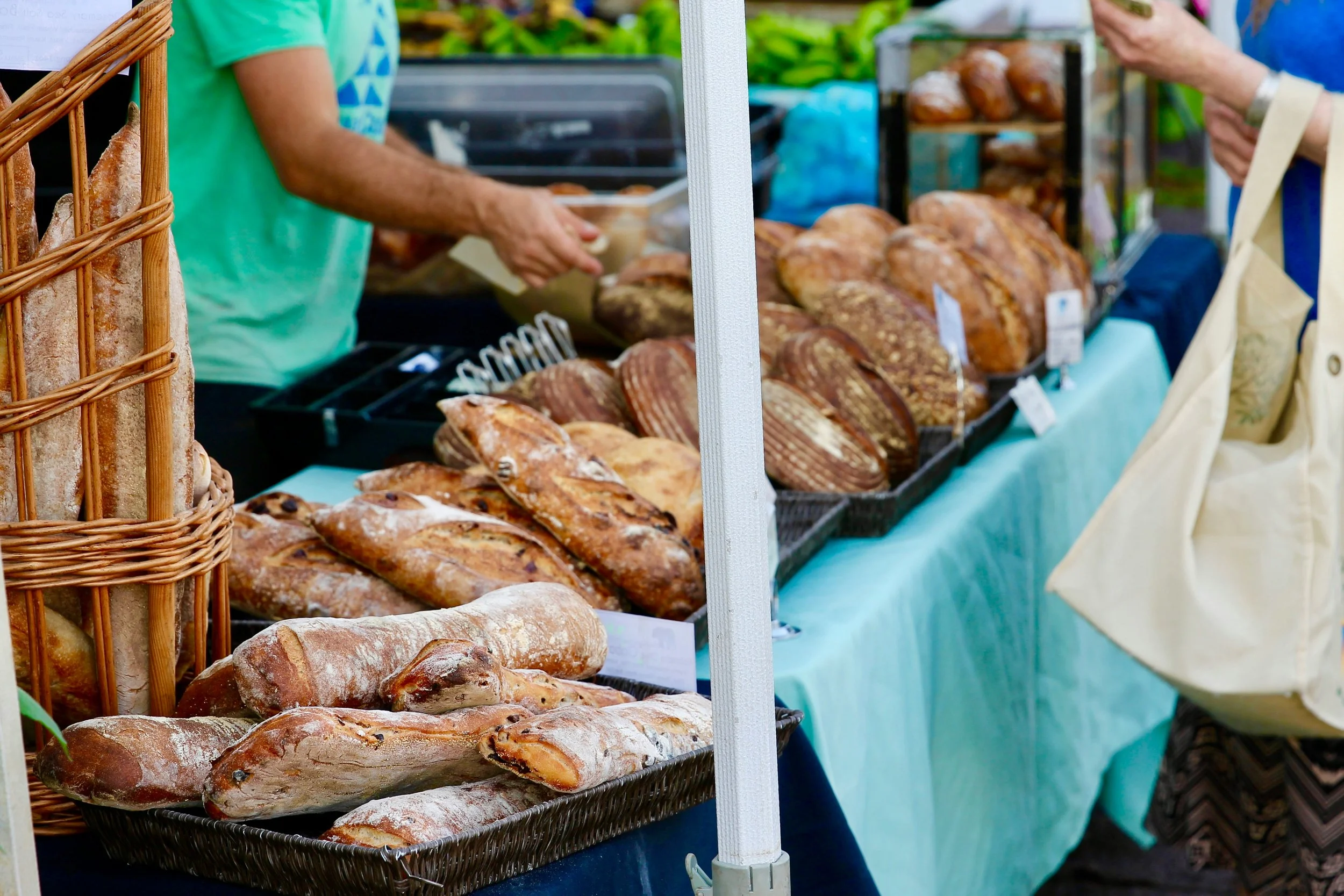
The Cold Spring Farmer’s Market: My Happy Place each week!
A Farm Vendor, a Security Guard, My Father, and a Revelation
There is a particular kind of tired that only a Saturday morning at the farmers market can undo. I have shown up blue, scared, and running on fumes more times than I can count, and I have not once come home in the same state. Something about the walk between vendor stands resets me. I am not talking about the produce, although the tomatoes do help. I am talking about the people. Over the years, the vendors have stopped being vendors. Some know my order before I ask. A few of them, if I am honest, have become something closer to family than acquaintance.
That word, acquaintance, is doing a lot of quiet work in this post, so let's look at it directly.
Most of us were raised on a fairly narrow definition of what counts as real connection. Close friends. Family. The handful of people who would show up at 2am. Everything short of that gets filed under small talk, the stuff you get through on your way to something that matters. I never fully bought that hierarchy, even before I had language for why. Augie, the custodian at my high school, was one of my people long before I understood that counted. So were Tony and Marie, the shoe cobbler and his wife I wrote about here, whose shop I visited for years and whose family I came to know, one repair at a time.
The research has caught up. Psychologists Gillian Sandstrom and Elizabeth Dunn ran a study where people either had a brief, genuine interaction with a barista, eye contact, a smile, a few words, or moved through the transaction as efficiently as possible. The people who engaged reported more positive affect than the people who stayed efficient. In a separate set of studies, people felt happier and had a stronger sense of belonging on the days they had more contact with acquaintances, not just close friends and family. The effect held even when they controlled for personality and time spent with strong ties.
What this means, in plain language, is that the people we think of as peripheral, the barista, the vendor, the person at the desk, are not a lesser category of relationship we tolerate on the way to the ones that count. Sociologists sometimes call them weak ties, which is an unfortunate name for something that turns out to be load bearing.
I wrote about some of this territory in January of 2024, when Community was my Word of the Year. I talked then about connection, belonging, and what I call the wisdom of the crowd. What I did not have language for yet was how much of that benefit shows up in the thin, ordinary moments. Not the retreat. The five minutes at the counter.
Here is a story that still delights me every time I tell it. There was a building I used to visit weekly for work, and over time I built a real rapport with the security guard at the front desk, the same smile-provoking “hellos” I have offered guards since my first corporate office visit, twenty-five years ago now. One day, almost by accident, he realized that a man who also came through that lobby regularly was my father, Stanley. It turned out he and my father had their own rapport too, entirely separate from mine, built the same small way. Two generations of my family, each independently inspiring a shot of oxytocin and a smile from the same person.
Writing this, I am noticing something I had not quite named before. Making a guard smile does something to me too. Research on emotional contagion shows that positive states pass between people and shape how safe and cooperative a shared space feels, even in brief exchanges. I offer a small hello, he smiles, and something in my own nervous system reads that as evidence the world is, in this moment, safe.
None of this is a strategy for optimizing your happiness. The farmers’ market vendor does not know she is part of my mental health maintenance. These relationships work precisely because they are not transactions dressed up as connection. They are just people, in proximity, choosing to notice each other more than once.
Here is the harder truth underneath the warm one. Culture already rewards efficiency over lingering. But there is a second, quieter pull working against us now: when we are stressed, the nervous system narrows outward attention as a matter of physiology, not willpower. Researchers studying social discomfort have found that arousal itself shrinks peripheral awareness, a measurable gating effect in the brain. Detachment in that state is not laziness. It is protective. Which means the moments when we most need a small hello are exactly the moments we are least wired to offer one. Nobody hands you rapport with your barista. You choose it, on purpose, against the grain of what stress is telling your body to do, in small unremarkable moments that will not feel significant until, years later, they turn out to be part of the architecture holding you up.
So here is a question worth sitting with, not answering immediately, just sitting with: who is already in your orbit, showing up in the margins of your week, who you have not yet let all the way in?
Is Coaching for you? Are you ready for it? Sign up HERE for a 15-minute Complimentary Coaching Consult to find out.